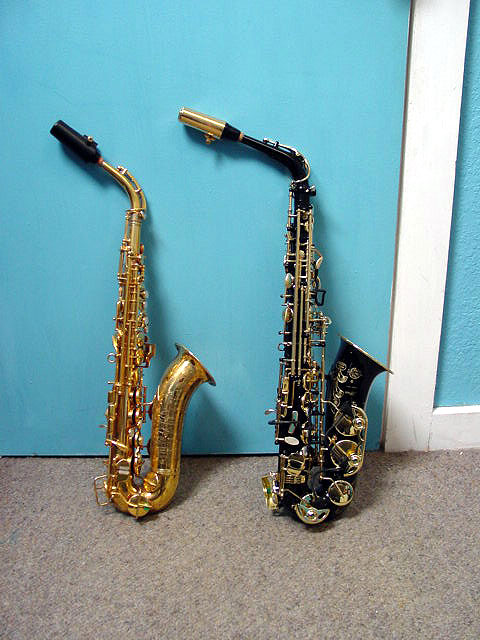
The saxophone is a combination of clarinet (the mouthpiece) the flute (the fingerings) and brass instruments (made of the same material). Although they appear to be a hybrid, saxophones have become very distinct instruments and there are several types of saxophones! The most common saxophone is the tenor saxophone, but baritone saxophone, alto sax, and soprano sax are all used in society. The soprano sax is the only saxophone that is straight (all others have the signature u-bend) and reaches the highest register for this instrument; on the opposite end of the spectrum, the baritone sax is very large and usually only played in professional orchestras. If a person is competent in playing the alto sax, it is usually not difficult to jump from one saxophone type to another type.
Tampilkan postingan dengan label Story. Tampilkan semua postingan
The saxophone is a relatively recent invention - it was created in the 1840's to bridge the tonal gap between lower woodwind section and the low brass section! The saxophone - informally called sax- is conical shaped and utilizes a reed in the mouthpiece, much like clarinets do. The saxophone is a hugely popular instrument and is a member of the woodwind family, joining the likes of flutes, piccolos, and clarinets. Normally, the saxophone is made of brass and it ranges in size, depending on the overall pitch (tenor sax is larger than an alto sax and soprano sax, for example). If you are tinkering with the idea of playing an instrument, the saxophone is a wonderful choice.
Your child is probably extremely excited, because they are about to start participating in the school band by playing the saxophone like Yamaha saxophone or Blessing saxophone. However, secretly you are biting your nails, because you are not sure whether or not you can afford a saxophone. Well, luckily there are a lot of different options and ways to buy a saxophone for your child. An option is available for you to allow your child to participate and learn the saxophone.
If you are extremely tight on cash, then you are going to want to talk to the director of your school music program about different options of getting a saxophone. A lot of times, the public school music programs will have some saxophone models that you can borrow for the year. This is the best and cheapest solution. The school program also has the ability to get a great discount on saxophones from the music stores. That's because they buy such a large volume of instruments, they get a bulk discount. If you can get in on one of these buys, then you will save a lot of money.
Another option is to buy a saxophone that is used. What's interesting about musical instruments is the fact that a lot of kid quit and the parents are stuck with a used instrument. This happens to leave a lot of used saxophones on the market for you to snap up. So, keep an eye out for kids who are quitting the school music program and need to sell their horns. If you're lucky, you can find a saxophone that is practically brand new. Your child will never know the difference. Also, this will allow you to save money for the future, when and if your child advances and needs a more professional instrument down the line.
Going To Kansas City
Charlie Parker was arguably the most influential saxophone player in jazz history. He was born on August 29, 1920 and was fortunate enough to be raised in Kansas City at a time when the music scene was in full stride. He took up alto saxophone at age 11 and was soon sneaking out of his house at night and into the nightclubs and theaters to watch and learn from the jazz greats of the time. Parker claimed to have learn a lot about playing saxophone by watching the fingers of the great Lester Young move up and down on his saxophone keys.
Yardbird
The older jazz musicians would hang out in the alleys during breaks and soon took a liking to this young kid. They helped sneak him into the clubs. Because of his fondness for eating chicken they gave him the nickname Yardbird. This was later shortened to the name he was known the world over for, Bird. As a teenager Parker became a serious musician who practiced 12 to 15 hours per day. He was soon playing in local bands and joined Jay McShann's territory band 1938. This band embodied the Kansas City jump blues style and toured the southwest as well as Chicago and New York.
Yardbird
The older jazz musicians would hang out in the alleys during breaks and soon took a liking to this young kid. They helped sneak him into the clubs. Because of his fondness for eating chicken they gave him the nickname Yardbird. This was later shortened to the name he was known the world over for, Bird. As a teenager Parker became a serious musician who practiced 12 to 15 hours per day. He was soon playing in local bands and joined Jay McShann's territory band 1938. This band embodied the Kansas City jump blues style and toured the southwest as well as Chicago and New York.
While many know the reputation Taiwan has in the manufacturing of high-tech electrical components, few may know of the growing saxophone business based in Houli. Long known as the music capital of Taiwan, Houli is located in a rural township in northwestern Taichung County. This area is also known for sugar cane, soybean, grapes, wine, and iron plants. While the population of Houli is about 50,000, it produces an amazing 40,000 saxophones a year.
The Taiwan saxophone industry dates back to just after World War II when Chang Lien-Cheng, a farmer's son that abandoned the family land to become a painter and musician, created an organized Jazz Band in 1945. Their performances throughout Taiwan were widely acclaimed until the area suffered a great fire and the only saxophone of the band was so seriously damaged that it could not be played any longer. Chang began by making an accurate drawing of the saxophone which contained about 400 components. He then started to transform the drawing into a real saxophone. After 3½ years, the first handmade Taiwan saxophone was made. Due to its very good quality, people all over Taiwan began to be captivated by the saxophone. Until Chang's death several years ago, he trained a number of apprentices, and in the process, launched a lucrative export industry. By the 1980s, Taiwan was churning out so many saxes under contract to labels in the United States and Europe, the government estimates that one out of every three saxophones in the world was made in Taiwan. Later, mainland China began ramping up its saxophone assembly lines, but these instruments were of a much lower quality. Despite the quality issues, the orders in Taiwan dwindled virtually overnight to a fraction of what they had been. During this time, about half of Houli's workshops went out of business.
The development of Fender amplifiers nearly coincided using the corporation's electric guitars within the middle nineteen forties. The first venture into the amp marketplace through Fender had been marked by the production of what they called the "Tweed Amps" which, in fact, had a result ranging from three to seventy five watts. However, these types of amps had a built-in circuit that was previously comparatively much feeble as well as reduced and for this reason have been not able to create the desired sound impact. As being a result, Fender revived the actual Tweed range as well as also are released it once again inside the 1950s, and it may be stated which after that upon, presently there continues to be absolutely no searching again.
During this time only, two extra types of amplifiers additionally began to turn out to be out there namely the "wide panel" as well as "narrow panel" amplifiers. Though built on nearly the same tips, these amps differed with regards to the design utilized to the doorway sections. The thickness for the sections around the main as well as underneath the speaker area acquired diminished wide as well as linen in the speaker grill also was substituted along with dark brown colored plastic material cloth. On the way to the later fifty percent of nineteen fifties along with the earlier Sixties, 2 a lot more manufacturers associated with Fender amps received prepared to strike the marketplace.
As a saxophonist and recording artist, I often hear from people who share with me their stories about how the sound of the saxophone effects them in their hearts, their souls, and their lives. There is something about the sound of the saxophone that has a clear and profound effect on many, many people.
Here are a few typical comments I hear on a very regular basis:
"It puts me in the mood, and helps me to remember how lucky I am to have someone to love."
"...it is soothing and healing to my heart and soul."
"The sounds just captivate and take the mind to a beautiful day."
"The music actually helps me to purge the day's stresses and cleanse the thoughts that I don't want to carry over into the next day."
"...it put me into a trance. In my mind I was transported to a Paris street side café looking into the eyes of my wife; it was a magical daydream - the air was filled with love."
Before I go any further, I should point out that I've been playing the saxophone for 43 years and I do have some modest talent on the instrument. I do know how to play the saxophone in just the right way so people react as in the examples above.
However, the point I'm making in this article has nothing to do with me specifically. It has to do with the saxophone itself, and how the very sound of the saxophone effects the human nervous system.
The point is that people love the saxophone!
Why? What it is about the instrument that inspires such reaction? Why is it such an attractive, compelling, magnetic, and powerful instrument?
My answer? Because the saxophone loves you.
Think about it. The saxophone has a warm, sensual, romantic, embracing sound, the very sound of love. It relaxes the mind and uplifts the heart. It inspires thoughts and feelings of love and romance. In some very real way, our psycho-chemical reaction to the sound of the saxophone is the same psycho-chemical reaction that takes place when we are actually experiencing love.
Admittedly, the conclusions I am drawing here are not scientific. I am not aware of any studies that have been done regarding the physics of the sound of the saxophone and how it effects human body chemistry. Nevertheless, it seems obvious from the extraordinary popularity of the instrument and how passionately people react to it that the saxophone has a powerful and profound effect on the human nervous system.
It is said that the saxophone sounds more like the human voice than any other instrument. Perhaps this is part of the mystique and power of the instrument.
But one thing is clear: certain tones made by the instrument resonate in a very specific way with the vibration of the human beingness. If played just right, the sound of the saxophone causes a powerful sympathetic vibration with the human nervous system.
So next time you hear a saxophone played just the way you like it, and you start thinking to yourself, "Ooh, yeah, that sounds nice!" remember this: the saxophone doesn't just sound good. The saxophone loves you.
"It puts me in the mood, and helps me to remember how lucky I am to have someone to love."
"...it is soothing and healing to my heart and soul."
"The sounds just captivate and take the mind to a beautiful day."
"The music actually helps me to purge the day's stresses and cleanse the thoughts that I don't want to carry over into the next day."
"...it put me into a trance. In my mind I was transported to a Paris street side café looking into the eyes of my wife; it was a magical daydream - the air was filled with love."
Before I go any further, I should point out that I've been playing the saxophone for 43 years and I do have some modest talent on the instrument. I do know how to play the saxophone in just the right way so people react as in the examples above.
However, the point I'm making in this article has nothing to do with me specifically. It has to do with the saxophone itself, and how the very sound of the saxophone effects the human nervous system.
The point is that people love the saxophone!
Why? What it is about the instrument that inspires such reaction? Why is it such an attractive, compelling, magnetic, and powerful instrument?
My answer? Because the saxophone loves you.
Think about it. The saxophone has a warm, sensual, romantic, embracing sound, the very sound of love. It relaxes the mind and uplifts the heart. It inspires thoughts and feelings of love and romance. In some very real way, our psycho-chemical reaction to the sound of the saxophone is the same psycho-chemical reaction that takes place when we are actually experiencing love.
Admittedly, the conclusions I am drawing here are not scientific. I am not aware of any studies that have been done regarding the physics of the sound of the saxophone and how it effects human body chemistry. Nevertheless, it seems obvious from the extraordinary popularity of the instrument and how passionately people react to it that the saxophone has a powerful and profound effect on the human nervous system.
It is said that the saxophone sounds more like the human voice than any other instrument. Perhaps this is part of the mystique and power of the instrument.
But one thing is clear: certain tones made by the instrument resonate in a very specific way with the vibration of the human beingness. If played just right, the sound of the saxophone causes a powerful sympathetic vibration with the human nervous system.
So next time you hear a saxophone played just the way you like it, and you start thinking to yourself, "Ooh, yeah, that sounds nice!" remember this: the saxophone doesn't just sound good. The saxophone loves you.
One of the most popular instruments in the world is the saxophone. If you doubt how popular it is, you simply have to look at Jazz and try and picture the genre of music without it. The truth is, the saxophone has a history that dates back to the 1840s with Adolphe Sax, who specialized in the clarinet. While working at his father's instrument shop, he began to work on an instrument that was a cross between a clarinet and a brass instrument. Through his work, he used the brass body of the ophicleide, the conical bore of the oboe and the fingering of the flute, with a single reed mouthpiece like the clarinet. The saxophone was truly a Frankenstein of instruments.
In 1846, he applied for a 15-year patent in 1846, which encompassed 14 versions of the design, split into two categories of seven instruments each, which ranged from sopranino to contrabass.
By the time his patent ended in 1866, numerous copies of the saxophone came into being that improved on the design and fingering methods. One improvement was making the bell slightly farther extended and adding one more key to extend the range downwards. While Sax's original fingering techniques were quite simple, they have become more and more difficult, thereby making the range of the saxophone much longer.
The saxophone has become a hallmark of a variety of different music genres, most notably Jazz, where it is an accepted piece of the music that helps the genre develop an amazing sound that cannot be equaled by very many other genres. Beyond that, it is often used in soft rock and other types of classical rock.
In 1846, he applied for a 15-year patent in 1846, which encompassed 14 versions of the design, split into two categories of seven instruments each, which ranged from sopranino to contrabass.
By the time his patent ended in 1866, numerous copies of the saxophone came into being that improved on the design and fingering methods. One improvement was making the bell slightly farther extended and adding one more key to extend the range downwards. While Sax's original fingering techniques were quite simple, they have become more and more difficult, thereby making the range of the saxophone much longer.
The saxophone has become a hallmark of a variety of different music genres, most notably Jazz, where it is an accepted piece of the music that helps the genre develop an amazing sound that cannot be equaled by very many other genres. Beyond that, it is often used in soft rock and other types of classical rock.
The saxophone was invented by a Belgian, Antoine Joseph (Adolphe) Sax in 1841 while he was in Brussels. Sax, an expert musician, became aware of the tonal disparity between strings and woodwinds, as well as brasses and winds. He noticed that the woodwinds were being overpowered by the brasses, and the strings were being overpowered by the winds. He wanted to create an instrument that would bridge the gap between these three instrument sections. Sax combined the body of a brass instrument and the mouthpiece of a woodwind instrument, and the saxophone was born. The brass was later replaced by metal. The instrument has a wide conical bore, a slightly flared bell, and a beaked mouthpiece similar to that of a clarinet. It is played with a single reed.
In 1845 the saxophone was introduced into French military bands. Until then these bands used oboes, bassoons, and french horns. Before 1845 the saxophone was scored for orchestra and opera, particularly in France.
Adolphe Sax patented the saxophone in France on June 28, 1846. The patent was for a period of fifteen years. The patent covered two groups of instruments with a total of 14. They were the E flat sopranino, F sopranino, B flat soprano, C soprano, E flat alto, F alto, B flat tenor, C tenor, E flat baritone, B flat bass, C bass, E flat contrabass, and F contrabass. Each instrument was of a different size. One group of seven was pitched alternatively in F and C, for orchestral use. The other group of seven was pitched in E-Flat and B-Flat for military band use. Saxophones are transposing instruments, which means that you do not play the notes exactly as they are written. Instead, you must transpose them. The only exception is the orchestral soprano in C.
The saxophone is the most popular and widely heard solo instrument of the wind family. Saxophones are played in many types of ensembles, including jazz, concert, wind ensemble and in marching bands.
The saxophone family includes the soprano, alto, tenor and baritone. Most new saxophone learners start with the alto saxophone. Reason being that a lot of classical saxophone books are written for the alto saxophone. In addition, the alto demands less from the player in terms of the air volume. The smaller key scale also fits very well in a young learner's hands. Finally, the alto saxophone is relatively lower priced so makes for a good starter instrument for a new learner.
Now that you have decided on which type of saxophone to buy, you will need to note the following points in selecting your saxophone:
1. Lacquer or plated saxophone
Saxophones are typically finished in clear lacquer. However in recent years, there is a choice of different colored lacquers. The color of the lacquer does not actually change the sound quality. However, plating of the instrument does affect tonal quality. Plated saxophone give out a brighter tone compared to lacquered ones.
Now that you have decided on which type of saxophone to buy, you will need to note the following points in selecting your saxophone:
1. Lacquer or plated saxophone
Saxophones are typically finished in clear lacquer. However in recent years, there is a choice of different colored lacquers. The color of the lacquer does not actually change the sound quality. However, plating of the instrument does affect tonal quality. Plated saxophone give out a brighter tone compared to lacquered ones.
If one is looking at purchasing a used saxophone, two presumptions or considerations may arise: first, that the person purchasing must get the item which will give him the best value for his money; second, that the person is using it for playing music. The importance of the second point is that saxophone, as a musical instrument, comes in different kinds. The difference lies in the music and pitch being produced by each type of instrument, sizes and shapes, as well as considerations which are related to the skill level of the player of the instrument.
Therefore, to be able to make the best decision as to which saxophone best suits any player of the instrument, it is important that one has a working knowledge of the different types of saxophones as well as the corresponding differences that distinguish one from the other. In doing this, one can effectively discriminate and choose the saxophone that best suits him.
There are generally four types of saxophones available in the market today. The first type is called the soprano saxophone. The soprano saxophone is tuned in the key of B flat (or Bb). It has the highest tune or pitch among all the other types of saxophones. Consequently, playing the instrument requires some skill because the pitch, being high, is more difficult to manipulate and manage. Therefore, most of the players of this type of saxophone are already adept at playing the instrument and are what can properly be considered as professional saxophonists.
The second type is the Alto Saxophone which plays at the key of E flat (or Eb). The position of this type of saxophone's bell allows its player to hear more of the sound produced by the instrument than by the other saxophones played. Most pieces composed for practice are also tuned in the key of Alto Saxophone. Consequently, it is considered as most befitting beginners and anyone whose skill level in saxophone is elementary.
There are generally four types of saxophones available in the market today. The first type is called the soprano saxophone. The soprano saxophone is tuned in the key of B flat (or Bb). It has the highest tune or pitch among all the other types of saxophones. Consequently, playing the instrument requires some skill because the pitch, being high, is more difficult to manipulate and manage. Therefore, most of the players of this type of saxophone are already adept at playing the instrument and are what can properly be considered as professional saxophonists.
The second type is the Alto Saxophone which plays at the key of E flat (or Eb). The position of this type of saxophone's bell allows its player to hear more of the sound produced by the instrument than by the other saxophones played. Most pieces composed for practice are also tuned in the key of Alto Saxophone. Consequently, it is considered as most befitting beginners and anyone whose skill level in saxophone is elementary.
Sugar Hill
Without a doubt one of the true giants of jazz tenor saxophone is Sonny Rollins. Born in Harlem, New York in 1930 Sonny began studying piano and alto saxophone at age 11. When Sonny turned 16 he switched to tenor saxophone in order to emulate one of his idols, the great Coleman Hawkins, who lived in his neighborhood. Thus began the development of one of the most unique and influential voices in jazz saxophone history.
Sonny grew up in the Sugar Hill neighborhood of Harlem surrounded by many jazz greats. Thelonius Monk took an interest in this young saxophonist and became his mentor. In 1948 at the age of 18 Sonny made his recording debut with Babs Gonzalez. Because of his immense talent he soon began working with jazz greats such as Charlie Parker, Bud Powell, Max Roach, Art Blakey, Fats Navarro, Miles Davis and the Modern Jazz Quartet.
Without a doubt one of the true giants of jazz tenor saxophone is Sonny Rollins. Born in Harlem, New York in 1930 Sonny began studying piano and alto saxophone at age 11. When Sonny turned 16 he switched to tenor saxophone in order to emulate one of his idols, the great Coleman Hawkins, who lived in his neighborhood. Thus began the development of one of the most unique and influential voices in jazz saxophone history.
Sonny grew up in the Sugar Hill neighborhood of Harlem surrounded by many jazz greats. Thelonius Monk took an interest in this young saxophonist and became his mentor. In 1948 at the age of 18 Sonny made his recording debut with Babs Gonzalez. Because of his immense talent he soon began working with jazz greats such as Charlie Parker, Bud Powell, Max Roach, Art Blakey, Fats Navarro, Miles Davis and the Modern Jazz Quartet.
Reeds are basically a piece of cane (wood) that is cut down to be very thin on one side and thicker on the other. The reed works by blowing air across it and then it starts to vibrate and make a high "squeally" sound.
First, if you spend any time at a music store, you will notice many brands and styles of reeds. Let's talk about some options. It is cheaper to buy reeds in a box rather than individually. Always buy reeds for your type of saxophone i.e. alto buys alto reeds, tenor buys tenor reeds etc. You will also see that reeds are sized in numbers 1-5, and in another system that goes soft to hard. Most reeds are using the number system. More expensive does not mean better. I would start out with a Rico Royal size 2.5. If you go with a Vandoren reed (a little more expensive) go with a size 2. The Vandoren reeds and the Rico Royals come in a variety of different cuts. On Vandorens choose the one in the blue box. They also make Java, V-12 etc. but just choose the regular old blue box reed. On Rico Royals, just pick the Rico Royal brand.
Middle Man
Although throughout the history of jazz there has been a large number of incredibly talented saxophone players, it is a well accepted fact among jazz scholars that three of the most important to the evolution of jazz saxophone were Coleman Hawkins, Lester Young and Charlie Parker, in that order.
Lester Young bridged the gap between the early jazz improvisations of Coleman Hawkins and Charlie Parker and the bebop revolution. Coleman Hawkins was considered the King of the tenor saxophone players during the early Swing era with his big tone and mastery of chordal improvisation. Lester Young arrived on the jazz scene with a totally new approach.
Mr. Cool
Lester Young rose to prominence out of Kansas City, during its musical boom years, while playing in the Count Basie big band. His tone was very relaxed and soft sounding, and he played in a very lyrical fashion with phrasing that was unorthodox at the time. His approach to improvisation was linear - he would play across the bar lines melodically instead playing up and down the chords like Hawkins tended to do.
Lester Young bridged the gap between the early jazz improvisations of Coleman Hawkins and Charlie Parker and the bebop revolution. Coleman Hawkins was considered the King of the tenor saxophone players during the early Swing era with his big tone and mastery of chordal improvisation. Lester Young arrived on the jazz scene with a totally new approach.
Mr. Cool
Lester Young rose to prominence out of Kansas City, during its musical boom years, while playing in the Count Basie big band. His tone was very relaxed and soft sounding, and he played in a very lyrical fashion with phrasing that was unorthodox at the time. His approach to improvisation was linear - he would play across the bar lines melodically instead playing up and down the chords like Hawkins tended to do.
Saxophone, one of the best instruments to learn (in my opinion)! You will soon come to find that playing the saxophone is not only fun, but it also teaches discipline and the sense of achievement is priceless.
Note about Equipment
Some sax players spend an inordinate amount of time thinking about equipment...
Tiger Woods would still beat you at golf if he used crappy clubs.
But maybe not if he used a baseball bat and a volleyball.
So have make sure your saxophone, mouthpiece, reeds, etc are functioning. But DO NOT spend more time worrying about your equipment than actually playing & practicing.
The saxophone itself has a body and a neck. The mouthpiece goes on the neck and has a reed held on by a ligature. The mouthpiece, reeds, and ligature matter sometimes more than the horn itself.
Note about Equipment
Some sax players spend an inordinate amount of time thinking about equipment...
Tiger Woods would still beat you at golf if he used crappy clubs.
But maybe not if he used a baseball bat and a volleyball.
So have make sure your saxophone, mouthpiece, reeds, etc are functioning. But DO NOT spend more time worrying about your equipment than actually playing & practicing.
The saxophone itself has a body and a neck. The mouthpiece goes on the neck and has a reed held on by a ligature. The mouthpiece, reeds, and ligature matter sometimes more than the horn itself.
The saxophone is an enchanting musical instrument and many people who first hear it's mellifluous tones are captivated by the sound of a sonorous saxophone and straight away desire to play it. But the saxophone is not an easy instrument to play. So much so it is one of the hardest instruments to master and particularly so for the young, usually a lot of commitment is needed to conquer this, the king of Instruments.
Often kids will first hear the saxophone on the Simpsons when Lisa tries to play this elusive of instruments. And so many kids start wanting to play just from seeing this program. And so begins the venture - where to purchase one what will it cost? This article focuses on these subjects plus will provide answers to them.
However, as most Moms and Dads realize, a child attention can stray so quickly, and one favorite activity can change very quickly, so why go spending several hundred dollars on a saxophone if it is going to spend a huge amount of time neglected in some closet? So with this and so many other situations with children, the answer may lie in getting a second hand or at least discount instrument to start off with and you can find these for as little as $50. Then after a few lessons you can decide the next step.
There have been many great tenor saxophone players throughout the history of jazz, but one of my favorites is Dexter Gordon. Perhaps what I like best about Dexter Gordon is his big, beautiful sound. He stood 6' 6'' tall, and he had a saxophone tone to match his stature with a warmth and body to it that was unmistakably his own.
Under A Doctor's Care
Gordon was born in L.A. In 1923. His father's name was Frank Gordon, and he had the distinction of being one of the first African American doctors practicing medicine in Los Angeles. As luck would have it two of his patients were jazz greats Duke Ellington and Lionel Hampton. Dexter began playing clarinet when he turned 13. He soon switched to saxophone, and by his senior year in high school this amazing talent was offered a job in the Lionel Hampton big band. Never hurts to have an in.
Langganan:
Postingan (Atom)