Tampilkan postingan dengan label Learning. Tampilkan semua postingan

How to Choose a Saxophone

If you are planning to buy yourself a Saxophone, as a beginner, you need to know which one to choose. Firstly, you need to set a budget for your Saxophone, how much can you spend on it? For how long will you be using the Saxophone? Which type are you looking for? Keeping all of this in mind, you go to a musical instrument seller and ask them for your Saxophone.
The most popular sellers for a Saxophone are Yamaha and Jupiter. Of course, Saxophones are really expensive, so you need to look out for the one that fits your budget. You can either pick up a popular brand like Yamaha or choose a Chinese make which would be less expensive. The quality of the Chinese make wouldn't be the same as Yamaha. But for a beginner, it is good and reasonable, and can be used for a short period of time.
If you want to buy a Soprano Saxophone or the Soprano Saxophone, you will need to remember that they are difficult to learn. Since the Soprano Saxophone is heavy, it is advised to purchase it after you've mastered the smaller ones. You will also need to know the type of music you will want to play on your Saxophone. If you want to learn to play Jazz music as a beginner you can buy an Alto or Tenor. If you want to play Rock and roll, you can buy a Tenor, and for playing classical you can buy the Classical Tenor Saxophone.


Learning Beginner Acoustic Guitar Lessons in a Breeze

The guitar is a wonderful instrument. It covers a wide genre of music; from rock, blues, jazz, classical, etc. It is also relatively easy to learn to play. But as with any other skill, it requires a lot of patience and practice to work. The first thing one should do when taking beginner acoustic guitar lessons is to find out which hand he uses to play the guitar with. Most people assume that just because you are left or right handed, you will also play the guitar the same way. Since you use two hands, one for strumming and one for the fret board, it is important to know which hand is to be used for each purpose. The reason for this is a guitar's strings are usually aligned with the thickest string on top, gradually thinning down as it reaches the bottom. With this setup, the left hand is used to tap the frets, and the right hand is used for strumming. If you feel that your left hand is much suited to handle the strumming, and that the right hand for tapping notes, then the strings need to be attached the opposite way; starting with the thinnest string on top, and the thickest one at the bottom. A very famous guitarist who plays the guitar this way is Jimi Hendrix.


Digital Pianos V Acoustic Upright Pianos, Ultimately It's Your Decision!

Digital pianos are electronic instruments that reproduce piano sounds. Unlike traditional upright pianos, they have no hammers, no strings and no soundboard to produce the sound you hear. Instead they have electronic sound chips and speakers.
Investing in a new piano can be a somewhat overwhelming experience with so many brands, models, styles and finishes available. Your first decision may well be whether to buy a traditional acoustic upright or a digital piano. The following unbiased information will help you to decide and hopefully make the process clearer for you.
Even with today's sampling technology individual notes may be quite accurately reproduced, but the tone of notes sounding together, as in an acoustic piano - with complex harmonics resonating against a flexible wooden soundboard - cannot be 100% matched. Many people also prefer the appearance of a traditional piano, which too is an important factor to consider. A good upright piano will hold its value much better than a digital. They can last anything up to 100 years, while digital models are constantly being upgraded and would not hold their original value.
Digital pianos usually have a variety of features that make them an attractive alternative to an acoustic piano, whilst still having 88 piano style "weighted keys" (these mimic the feel of an upright piano). Some of these features are as follows:


Acoustic Flooring Can Keep You Out Of Trouble

Any considerate homeowner should be respectful of those around them. You have a responsibility to keep levels of sound down to a minimum as no-one wants to be subject to excess levels of noise. It can sometimes be difficult to keep quiet in the home, but instead of just accepting this, you should take some form of action to ensure that sound does not get out of control.
Acoustic flooring is one of the most effective of soundproofing products as it can:
· Allow you to play music in the home without having to worry about it interrupting those next door or underneath your property.
· Give you the chance to watch your favourite films in surround sound so you can replicate the cinema experience.
· Help you play any musical instruments that you may have and want to practice playing in the comfort of your own home.
· Prevent the sound that you or any guests that visit create from transferring into other nearby living spaces.


Learning Acoustic Guitar - Simple Tips and Advice

As we think of the traditional guitar the earliest object that comes to mind is the acoustic guitar. Electric guitars didn't show up on the picture until the initial 1930's. The acoustic guitar however, has been strummed since 1779. The particular guitar has been used by a lot of bands inside their unplugged sessions generally meant for its skill to generate a sound rich with natural emotion and richness. No amplifiers are used with the guitar.
Have no worry if one are taking into account learning acoustic guitar, it is quite straightforward and fun. Education on the guitar is fun if they are properly planned and varied.
Beginners most likely discover that what to study initially can be a challenging task. Maybe the very frustrating matter for a starter is to make your correct fingering on the strings to produce a chord. After a small amount repetition and exercise one will be able to produce a fine sounding chord. Just befall tolerant and eventually it will occur to you in calculate. Finger strength plays a crucial role concerning training how to play chords. At hand are a lot of exercises finger and hand exercises that can help you with this.


10 Reasons Why Acoustic Flooring Could Be A Worthwhile Investment

Acoustic flooring and other sound control products are excellent to reducing noise to give both you and those you live nearest to a better quality of life. Here are 10 reasons why you may want to consider investing in acoustic flooring.
1. If you like to play your music on a high volume, you may want greater sound control in order to limit what can be heard by your neighbours or people passing the property.
2. Film fans will relish the freedom that acoustic flooring can bring when embracing a full range of home entertainment technology to create the perfect cinema experience in their own house or flat.
3. If you're a musician who wants to be able to rehearse in your own home without disturbing others, new sound control or acoustic insulation could be the answer.
4. While neighbours don't tend to mind the odd party, especially if you invite them, regular gatherings could affect their quality of life if they are going on through the night.


Acoustic Guitar Lessons - All You Need To Know

Just before you start taking full acoustic guitar lessons, there are a few facts that should be looked after. And one of the most essential points could be the type of music you will be deciding on playing just after completing the acoustic guitar lessons. After having decided on the kind of music and songs that you like to study, you may then likely think of the subsequent stages in the acoustic guitar classes.
The simplest way to start off your acoustic guitar training could be to pickup a song that you genuinely appreciate and also would wish to play on the musical instrument. This will not simply enable you to understand the instrument more rapidly, nevertheless it could as well have the whole encounter fulfilling. It'll guarantee that there is absolutely no boredom floating around and this will also result in you not becoming disappointed.
Soon after having chosen the particular music to be performed, you must now take a look in to the fundamentals within the instrument and that is the chord as well as the scale. Chords are in essence a mixture of the different musical notes and the scales are simply just the expansion of the guitar chords. Their uses are generally mixed, though they harmonize with one another well. The guitar chords are useful while you're seeking to sing along. These kind of scales are of help while using the solo editions. Understanding the concepts of the scales is critical as that can assist you along with the easy movement of your fingers.


One Important Thing That Might Be Forgotten by You in Acoustic Guitar Playing

Have you ever felt that the sound of your guitar is not like as you want? Then you check your guitar if it's been tuned yet, and still you feel there's something wrong. Or perhaps you don't like the sound.
In this context, acoustic guitar is a guitar with steel strings. As you know, there ares some techniques of thrumming in playing your acoustic guitar. Is it using fingering style or picking style.
I will describe it about fingering style first. Fingering style is thrumming technique that only use finger. For example, thumb finger is usually for strum 4th, 5th, 6th string and other finger like index finger, middle finger, and ring finger has their on job for strumming 3rd, 2nd, and 1st string.
Even thought in reality many guitarist not always use that rule. Sometimes they strum high strings with their thumb. But the principle is almost all your fingers be used for thrumming the strings. This technique is very helpful if a guitarist want to play two notes at the same time.


The Benefits Of Live Acoustic Guitar Lessons

If learning how to play the acoustic guitar tops your bucket list, it may be time to enroll yourself in acoustic guitar lessons. While you may have the guitar on hand and the sheet music to play, having everything you need does not mean anything unless you learn the essential skills necessary to read sheet music and play the guitar.
While there are free tutorials and videos available online to teach you how to play the acoustic guitar, not everyone learns in the same way. Face-to-face guitar lessons give you the attention you need to build your skills. If you are researching which type of acoustic guitar lessons are for you, consider the benefits of live lessons.
Unlike online lessons, live guitar lessons are in your face and allow you to communicate with your instructor. While online classes are convenient, studies have shown that many individuals will give up because lessons do not suit the student's learning style. With live lessons, students can request an instructor who is willing to teach the student at a pace they can keep up with.


Beginner Acoustic Guitar Lessons: Training Your Ear

One important technique for beginning guitar players is the ability to train your ear. When you actively train your ear, you will be able to (over the course of time), play songs you hear instantly on your guitar. But before you are able to do this, you must take a couple of things into account.
You first should focus on interval training. Instead of learning a piece of music by heart, divide it into intervals. The trick is to learn to distinguish the intervals. If you can distinguish the intervals, it is easier for you to figure out which chords are used in a particular song.
The second step in training your ear should be the focus on hearing Major vs. Minor. Pick out the root of the chord that is being played and tune out the melody. Now you should be able to determine what is being played as backing chords. After that try to pick out the extension.


A Breedlove Guitar and the Quality it Provides

Without a good quality instrument, it is not possible for a musician to make beautiful music. A Breedlove guitar is so well made that many guitarists will only play one of their models. This company makes wonderful instruments using only the best possible materials.
The first thing you will notice on their website is that they offer two classes of guitars, the Original and the Revival. Both groups are built to the same quality standards, but off their own unique features. A musician will generally prefer one of them, depending on what they require of their guitar.
A thicker and shorter treble side on the Original gives superb resonation to any high notes they play. Bass notes are allowed better resonation due to that side being both longer and thicker. The soundboard is stiffened and relaxed, in order to sustain the notes, with their bridge truss system. A pinless bridge that is also winged makes use of a scalloped bracing for balance of the strings.
More lightweight and making use of X braces to allow for balance and power is the Revival series. You can also play ore precise root notes, because they are made in a graduated thickness. They can be played powerfully and fast, thanks to their pinned bridge. These models are specially made to allow for clear chording and flat picking.
Under each model class there are, of course, different guitars to take under consideration. Guitars are not the only instruments they make, however. You can look through their product line and find ukuleles, basses and mandolins. The companies great dedication to quality goes into each one.


The Saxophone

The saxophone is a wonderful instrument that adds depth and variety to many pieces of music. It is a woodwind instrument and it uses a single reed attached to its mouthpiece. The reed vibrates as the air passes through it to allowing the saxophone to produce its great sound.
In the early 1800's, Adolphe Sax noticed that there was a bit of a gap between the brass and woodwind sections of the orchestra. The gap was produced because of the relatively quiet sounds produced by the woodwinds and the lack of versatility of pitch range among the brass instruments. Therefore, he developed the saxophone which gave strength of voice to the woodwinds and flexibility to the brass. He developed the instrument in 1841 and actually developed two different groups of the instruments. Between the Sopranino saxophone and the Contrabass saxophone, the one group of these instruments could span the entire range offered by a piano. Many of these are transposing instruments which lend a whole different set of abilities to the saxophones.


Saxophone and its Types

Music has always been an inevitable part of human life and many of you may love to hear good music or play music for your own satisfaction and contentment. There are different types of music instruments such as saxophones, trumpets, guitar, piano that are used by people to fulfill their music love. Of these saxophones is still the most rare and appreciable music instrument by the people.Saxophone was invented by Adolph Sax in the 1840's and is not really an instrument but a group of instruments. Sax has invented about fourteen saxophones out of which eight still exists. However, only four of them are commonly available - the soprano, alto, tenor and baritone saxophones. Out of these, the alto saxophone is most commonly found which most people think of.


How to Fix a Bad Saxophone Reed

If I have a reed that will not play for me, I have a set of steps that I will take. Many reed problems can be fixed by sanding the back of the reed to make sure it is flat.
Your mouthpiece table should be flat, and the back of the reed should also be flat. If you take your reed and lay it down on a very flat surface, such as a piece of glass, you can gently rock the reed back and forth and see if it is flat. My favorite way to check, is to take the reed, lay it on the flat surface, put even pressure on the entire reed with my fingers, and rub it around in a circular motion on a clean piece of paper. Do this for about 30 seconds, then pick up the reed and look at the back. You will see that some parts of the reed are shiny and some are not. The shinny parts are high spots, and the dull parts are low spots.


What Type Of Saxophone Should I Play?

Thinking about playing the saxophone? Adolphe Sax, it's inventor drew up plans for 14 different types of saxophones. I don't know how far he got with that list but I have heard of 11 and personally have seen or played 8 of them. The 10 different voices (types) are sopranissimo, sopranino, soprano, saxello, alto, c melody, tenor, baritone, bass, contrabass, and subcontrabass.
Alto or Tenor?

Let's talk about these two since they are the most popular followed by soprano and baritone. Many people wouldn't really know the differences between the alto and tenor saxophones if they glanced at them from a distance but there is a big difference between them.


Things to Consider When Buying a New Saxophone

Buying a new saxophone requires minimal knowledge of the types of saxophones available in the market as well as the differences that distinguish them from each other. Saxophones are generally categorized into four types. The first would be the soprano saxophone which is in the key of B flat. Its sound or pitch is higher compared to the other saxophones and is therefore generally considered as the hardest to play. This is not recommended to beginners who are not yet adept at playing the instrument. The second type is called the Alto Saxophone and is in the key of E flat. It is the one commonly played most especially by beginners. This type of saxophone is recommended to beginners because most of the practice materials and compositions for beginners are in the alto pitch. The third one is called the tenor saxophone. It is in the key of B flat and is mostly used for playing jazz and blues as well as rock music. However, the neck of this kind of saxophone is longer than the other types of saxophone making it more prone to damage. The fourth kind is the baritone saxophone. It is usually played for jazz solos. It is the largest among the other three types of saxophone that its players will have to wear a harness to support its weight.


Recording Techniques For Saxophone

Here are some techniques and ideas you may find useful for recording. Many of them will apply to other instruments as well. Whether you do it yourself or record in a studio or at live performances, it's essential that you know how to get your best sound, and what to do with it once you have it tracked. Don't assume that the engineer will know exactly how to get it for you - you will have to work together.Like many acoustic instruments, the sax records well with the use of a condenser mic. Condenser mics differ from dynamic mics in that they usually require a battery (or phantom power supplied from the mixer) and have a broader pick up pattern which makes them less useful on stage because they tend to feed back. They provide a flatter response, meaning that all frequencies are presented more equally whereas dynamic mics are often 'coloured' to bring out voice tones.
When recording with a condenser mic, you can 'back off' with it at eye level up to three feet away from your face, or 'close mic' keeping it aimed near the bottom of the left hand over the bell as you would performing live. Most of us have discovered not to aim it down the bell as this can do some awesome damage when you let go with a low Bb. Your choice of mic, playing style, and recording set-up will determine just where to place it. If you are recording yourself, set up a few tracks to record and compare. You'll need it later to set the equalization (EQ).


Understanding the Difference Between Saxophone Types For the Non-Musician

Saxophone Types
As a music student coming from a non-musical family, I get asked a lot of interesting questions sometimes. I have found, as a saxophonist, that many people do not realize the physical differences between saxophone types. Here is a quick run down on the more common types of saxophones and how one can identify them easily. You will be a saxophone-identifying-pro in no time!
Soprano-- Most commonly referred to as "the straight one," "the gold clarinet," or my personal favorite, "the one Kenny G. plays." However, a word of caution: not all soprano saxophones are straight! Straight ones are more common but not long ago, curved sopranos were pretty popular as well. A curved soprano is very small... a grown person holding it, in my opinion, looks kind of funny just because it looks like an alto saxophone that got put into a dryer. However, at the very top, where the mouth goes, it is often a bit more straight even if it is a "curved" soprano. If it is really small, assume that it is a soprano (or something even higher pitched... which we will get to later!).


Saxophone Blues Scales - If You Want To Play Blues, Rock or Jazz You Need To Start Here

Blues Saxophone
If you're a saxophonist interested in playing any type of blues based music including rock and roll and even jazz then you need to use the blues scale as your number one tool to make things sound right.
A little history
If you want to investigate back to the beginnings of the blues as it came about in America just start with W.C. Handy, who was a black composer active in the early 1900's when the blues form began to get popularized in large part because of his instrumental compositions "Memphis Blues" (1912) and "St. Louis Blues" (1914). Of coarse the blues oral tradition can be traced back to the mid 1800's.
The blues scale
Because our western music has it's roots in European classical music the music theorists needed to notate the blues scale as it was naturally played and sung into an understandable notation which could be analyzed and played by western trained musicians.
The simplest way to explain it's theory is this:
Simply take the traditional major scale; C D E F G A B C and flatten the 3rd, 5th, and 7th. Now it looks like this: C D Eb E F Gb G A Bb C.
Notice the E, G, and B have been flattened, they are the 3rd, 5th and 7th notes of the C major scale and flattening them makes the scale sound minor thus giving it the "blues" or sad sound as opposed to the "major" or happy sound.


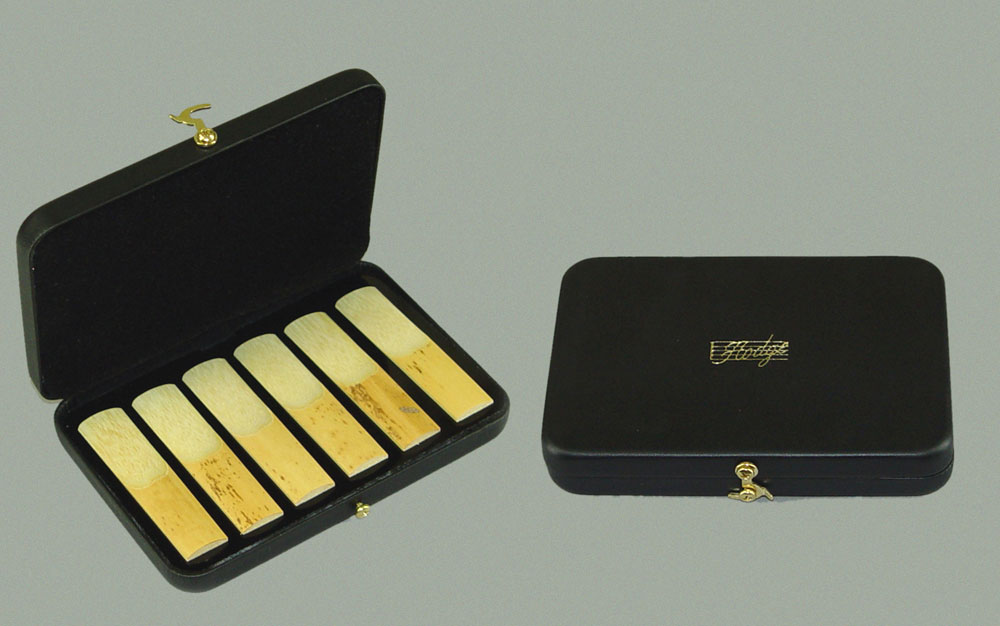
How to Choose Saxophone Reeds

Saxophone Reeds
In this article we explorer various methods for choosing saxophone reeds. This article is written for the novice player, but experts might find the information useful as well. Let us get started.
As most players know, saxophone reeds are not cheap. Furthermore, they can be quite inconsistent in quality unless a synthetic reed is purchased. Saxophone reeds are made from natural products that cause large quality differences. These differences are present between sax reeds of identical brands and styles. Most manufactures do not implement strict quality control practices to ensure consistent production. However, in defense, we can not expect each reed to be inspected or played before shipping. This can cause issues for players of all skill levels. What do we do about this? Let us consider a few scenarios.
Some stores will not permit a detailed search of the sax reeds to find the best. In this situation, you buy a few of them, and hope it works out. In other situations, the store will allow a thorough inspection to find a good reed. Most high end shops will permit this type of action. Here is how we proceed:
First, take a good look at it. Hold the saxophone reed up to a bright light and examine it for any chips, cracks, or holes. Do not choose any with those defects. Be alert for discoloration in the wood grain. If you see discoloration with a non-uniform wood grain, then discard that reed. Ensure that the wood grain is not coarse and has a consistent width. The reed should look as uniform as possible. Inspect for flatness, and watch for imperfections. A slight curvature is acceptable, but it should be limited.
Now, lets check for stiffness. If the store allows, gently flex the reed. Be careful not to break it! A nice reed should be slightly stiff. If the reed feels loose (you will get better at this with experience), then choose another. A loose reed can indicate that it is out of balance, and it is important to eliminate this potential problem.
If you perform the steps above, you will definitely increase your chance of finding quality saxophone reeds. Now keep in mind, it is not always possible to eliminate bad reeds. Since it is not possible to play the reed before purchase, I recommend buying multiple reeds at one time in case of problems. I hope this article increases your chance of selecting quality saxophone reeds