Tampilkan postingan dengan label Info. Tampilkan semua postingan

Information About The Saxophone

The saxophone is a relatively recent invention - it was created in the 1840's to bridge the tonal gap between lower woodwind section and the low brass section! The saxophone - informally called sax- is conical shaped and utilizes a reed in the mouthpiece, much like clarinets do. The saxophone is a hugely popular instrument and is a member of the woodwind family, joining the likes of flutes, piccolos, and clarinets. Normally, the saxophone is made of brass and it ranges in size, depending on the overall pitch (tenor sax is larger than an alto sax and soprano sax, for example). If you are tinkering with the idea of playing an instrument, the saxophone is a wonderful choice.
The saxophone is a combination of clarinet (the mouthpiece) the flute (the fingerings) and brass instruments (made of the same material). Although they appear to be a hybrid, saxophones have become very distinct instruments and there are several types of saxophones! The most common saxophone is the tenor saxophone, but baritone saxophone, alto sax, and soprano sax are all used in society. The soprano sax is the only saxophone that is straight (all others have the signature u-bend) and reaches the highest register for this instrument; on the opposite end of the spectrum, the baritone sax is very large and usually only played in professional orchestras. If a person is competent in playing the alto sax, it is usually not difficult to jump from one saxophone type to another type.


Saxophone Purchase Options For Your Child

Your child is probably extremely excited, because they are about to start participating in the school band by playing the saxophone like Yamaha saxophone or Blessing saxophone. However, secretly you are biting your nails, because you are not sure whether or not you can afford a saxophone. Well, luckily there are a lot of different options and ways to buy a saxophone for your child. An option is available for you to allow your child to participate and learn the saxophone.
If you are extremely tight on cash, then you are going to want to talk to the director of your school music program about different options of getting a saxophone. A lot of times, the public school music programs will have some saxophone models that you can borrow for the year. This is the best and cheapest solution. The school program also has the ability to get a great discount on saxophones from the music stores. That's because they buy such a large volume of instruments, they get a bulk discount. If you can get in on one of these buys, then you will save a lot of money.
Another option is to buy a saxophone that is used. What's interesting about musical instruments is the fact that a lot of kid quit and the parents are stuck with a used instrument. This happens to leave a lot of used saxophones on the market for you to snap up. So, keep an eye out for kids who are quitting the school music program and need to sell their horns. If you're lucky, you can find a saxophone that is practically brand new. Your child will never know the difference. Also, this will allow you to save money for the future, when and if your child advances and needs a more professional instrument down the line.


Paramore To Release New Music This Summer

Paramore fans don't have too long to wait to hear new music from the band, as singer Hayley Williams says new songs will be released in the summer.
Williams and her band mates have been writing demos for their new album, following the departure of former members Zac and Josh Farro late last year.
And once their new tour wraps up this month, they're heading back in to the studio.
"We are going to go tomorrow to South America to do a tour. And then when we get back, we're hoping to record a batch of songs to release over the summer," Williams told AOL Music.
"All the details aren't worked out yet, but we definitely do want to release [new song 'In the Mourning'] and some other ones before we put out a record."


The Saxophone Loves You

As a saxophonist and recording artist, I often hear from people who share with me their stories about how the sound of the saxophone effects them in their hearts, their souls, and their lives. There is something about the sound of the saxophone that has a clear and profound effect on many, many people.
Here are a few typical comments I hear on a very regular basis:

"It puts me in the mood, and helps me to remember how lucky I am to have someone to love."

"...it is soothing and healing to my heart and soul."

"The sounds just captivate and take the mind to a beautiful day."
"The music actually helps me to purge the day's stresses and cleanse the thoughts that I don't want to carry over into the next day."

"...it put me into a trance. In my mind I was transported to a Paris street side café looking into the eyes of my wife; it was a magical daydream - the air was filled with love."

Before I go any further, I should point out that I've been playing the saxophone for 43 years and I do have some modest talent on the instrument. I do know how to play the saxophone in just the right way so people react as in the examples above.

However, the point I'm making in this article has nothing to do with me specifically. It has to do with the saxophone itself, and how the very sound of the saxophone effects the human nervous system.

The point is that people love the saxophone!
Why? What it is about the instrument that inspires such reaction? Why is it such an attractive, compelling, magnetic, and powerful instrument?
My answer? Because the saxophone loves you.

Think about it. The saxophone has a warm, sensual, romantic, embracing sound, the very sound of love. It relaxes the mind and uplifts the heart. It inspires thoughts and feelings of love and romance. In some very real way, our psycho-chemical reaction to the sound of the saxophone is the same psycho-chemical reaction that takes place when we are actually experiencing love.

Admittedly, the conclusions I am drawing here are not scientific. I am not aware of any studies that have been done regarding the physics of the sound of the saxophone and how it effects human body chemistry. Nevertheless, it seems obvious from the extraordinary popularity of the instrument and how passionately people react to it that the saxophone has a powerful and profound effect on the human nervous system.
It is said that the saxophone sounds more like the human voice than any other instrument. Perhaps this is part of the mystique and power of the instrument.

But one thing is clear: certain tones made by the instrument resonate in a very specific way with the vibration of the human beingness. If played just right, the sound of the saxophone causes a powerful sympathetic vibration with the human nervous system.

So next time you hear a saxophone played just the way you like it, and you start thinking to yourself, "Ooh, yeah, that sounds nice!" remember this: the saxophone doesn't just sound good. The saxophone loves you.


Lenny Pickett Tenor Saxophone Virtuoso

Lenny Pickett is best known as the tenor saxophonist of the Saturday Night Live Band, he is one of the virtuosos of altissimo saxophone. The altissimo register is a technique that almost seems like a requirement for saxophonists today. It's based on harmonics and enables you to achieve notes above the normal range of the saxophone.
For example, it is possible to finger a low Bb (the lowest note on the instrument) and by changing the embouchure and air stream to blow the full overtone series of the low Bb (middle Bb, middle F, high Bb, high D, high F, and so on.) This technique can be heard clearly in the well known opening theme to Saturday Night Live.
Lenny passes says this about his equipment, in response to numerous inquiries: "I play a Selmer Paris Mark VI tenor (circa 1970) with a Berg Larsen 130 over 0 (SMS) mouthpiece and a number 3 Vandoren (blue box) bass clarinet reed."


Joshua Redman Saxophonist - Jazz Saxophone

Saxophonist Joshua Redman may not quite be a household name like jazz legends Miles Davis and John Coltrane, but his contribution to music has been broad and important. Redman was born February 1, 1969, and at age 10 began to play the tenor saxophone. While studying in Berkeley's public school system, he was exposed to an exceptional jazz program that nurtured his natural abilities and enabled his entry to Harvard, where he graduated in 1991.
Shortly after graduation, he began to work in earnest on his musical career- with his style on saxophone influenced by Sonny Rollins, John Coltrane, Earth Wind and Fire, Led Zeppelin, Dexter Gordon, and more. Perhaps one of the most important influences in his music is his father, Dewey Redman, who worked with jazz Great Ornette Coleman. His father was rarely home during Redman's youth due to a grueling touring schedule. A young Joshua spent hours listening to his father playing on records, in the absence of the man himself.


The Saxophone

The saxophone is a wonderful instrument that adds depth and variety to many pieces of music. It is a woodwind instrument and it uses a single reed attached to its mouthpiece. The reed vibrates as the air passes through it to allowing the saxophone to produce its great sound.
In the early 1800's, Adolphe Sax noticed that there was a bit of a gap between the brass and woodwind sections of the orchestra. The gap was produced because of the relatively quiet sounds produced by the woodwinds and the lack of versatility of pitch range among the brass instruments. Therefore, he developed the saxophone which gave strength of voice to the woodwinds and flexibility to the brass. He developed the instrument in 1841 and actually developed two different groups of the instruments. Between the Sopranino saxophone and the Contrabass saxophone, the one group of these instruments could span the entire range offered by a piano. Many of these are transposing instruments which lend a whole different set of abilities to the saxophones.


Saxophone and its Types

Music has always been an inevitable part of human life and many of you may love to hear good music or play music for your own satisfaction and contentment. There are different types of music instruments such as saxophones, trumpets, guitar, piano that are used by people to fulfill their music love. Of these saxophones is still the most rare and appreciable music instrument by the people.Saxophone was invented by Adolph Sax in the 1840's and is not really an instrument but a group of instruments. Sax has invented about fourteen saxophones out of which eight still exists. However, only four of them are commonly available - the soprano, alto, tenor and baritone saxophones. Out of these, the alto saxophone is most commonly found which most people think of.


How to Fix a Bad Saxophone Reed

If I have a reed that will not play for me, I have a set of steps that I will take. Many reed problems can be fixed by sanding the back of the reed to make sure it is flat.
Your mouthpiece table should be flat, and the back of the reed should also be flat. If you take your reed and lay it down on a very flat surface, such as a piece of glass, you can gently rock the reed back and forth and see if it is flat. My favorite way to check, is to take the reed, lay it on the flat surface, put even pressure on the entire reed with my fingers, and rub it around in a circular motion on a clean piece of paper. Do this for about 30 seconds, then pick up the reed and look at the back. You will see that some parts of the reed are shiny and some are not. The shinny parts are high spots, and the dull parts are low spots.


What Type Of Saxophone Should I Play?

Thinking about playing the saxophone? Adolphe Sax, it's inventor drew up plans for 14 different types of saxophones. I don't know how far he got with that list but I have heard of 11 and personally have seen or played 8 of them. The 10 different voices (types) are sopranissimo, sopranino, soprano, saxello, alto, c melody, tenor, baritone, bass, contrabass, and subcontrabass.
Alto or Tenor?

Let's talk about these two since they are the most popular followed by soprano and baritone. Many people wouldn't really know the differences between the alto and tenor saxophones if they glanced at them from a distance but there is a big difference between them.


Things to Consider When Buying a New Saxophone

Buying a new saxophone requires minimal knowledge of the types of saxophones available in the market as well as the differences that distinguish them from each other. Saxophones are generally categorized into four types. The first would be the soprano saxophone which is in the key of B flat. Its sound or pitch is higher compared to the other saxophones and is therefore generally considered as the hardest to play. This is not recommended to beginners who are not yet adept at playing the instrument. The second type is called the Alto Saxophone and is in the key of E flat. It is the one commonly played most especially by beginners. This type of saxophone is recommended to beginners because most of the practice materials and compositions for beginners are in the alto pitch. The third one is called the tenor saxophone. It is in the key of B flat and is mostly used for playing jazz and blues as well as rock music. However, the neck of this kind of saxophone is longer than the other types of saxophone making it more prone to damage. The fourth kind is the baritone saxophone. It is usually played for jazz solos. It is the largest among the other three types of saxophone that its players will have to wear a harness to support its weight.


Recording Techniques For Saxophone

Here are some techniques and ideas you may find useful for recording. Many of them will apply to other instruments as well. Whether you do it yourself or record in a studio or at live performances, it's essential that you know how to get your best sound, and what to do with it once you have it tracked. Don't assume that the engineer will know exactly how to get it for you - you will have to work together.Like many acoustic instruments, the sax records well with the use of a condenser mic. Condenser mics differ from dynamic mics in that they usually require a battery (or phantom power supplied from the mixer) and have a broader pick up pattern which makes them less useful on stage because they tend to feed back. They provide a flatter response, meaning that all frequencies are presented more equally whereas dynamic mics are often 'coloured' to bring out voice tones.
When recording with a condenser mic, you can 'back off' with it at eye level up to three feet away from your face, or 'close mic' keeping it aimed near the bottom of the left hand over the bell as you would performing live. Most of us have discovered not to aim it down the bell as this can do some awesome damage when you let go with a low Bb. Your choice of mic, playing style, and recording set-up will determine just where to place it. If you are recording yourself, set up a few tracks to record and compare. You'll need it later to set the equalization (EQ).


Understanding the Difference Between Saxophone Types For the Non-Musician

Saxophone Types
As a music student coming from a non-musical family, I get asked a lot of interesting questions sometimes. I have found, as a saxophonist, that many people do not realize the physical differences between saxophone types. Here is a quick run down on the more common types of saxophones and how one can identify them easily. You will be a saxophone-identifying-pro in no time!
Soprano-- Most commonly referred to as "the straight one," "the gold clarinet," or my personal favorite, "the one Kenny G. plays." However, a word of caution: not all soprano saxophones are straight! Straight ones are more common but not long ago, curved sopranos were pretty popular as well. A curved soprano is very small... a grown person holding it, in my opinion, looks kind of funny just because it looks like an alto saxophone that got put into a dryer. However, at the very top, where the mouth goes, it is often a bit more straight even if it is a "curved" soprano. If it is really small, assume that it is a soprano (or something even higher pitched... which we will get to later!).


How to Choose a Saxophone Mouthpiece

Saxophone Mouthpiece
A professional mouthpiece will improve your sound more than any other part of your saxophone. I recommend that be the first piece of equipment that you buy to upgrade your sound. Mouthpieces will come in two types- Jazz and Classical. For general playing you will want a good classical mouthpiece. These will be plastic looking. They are called hard rubber. There are three excellent mouthpieces I recommend that are reasonably priced. The Rousseau 4R is about $70 and is fantastic. The 4R refers to the tip size. The Selmer S80 C* is another great mouthpiece. It will cost about $100 or so. The Rousseau New Classic plays like a S80 with a little different sound. It costs about $80.00. I recommend these mouthpieces for all of the saxophones.
Jazz mouthpieces are a little more complicated. If you play Alto, most people will go for a hard rubber mouthpiece as opposed to the metal, which tends to be a little bright for the alto. If you are going to play a lot of rock music, you may want that bright sound. My favorite mouthpiece for the alto for general jazz playing is the Meyer 6M. This is a classic that has been around for a long time. I would probably start here before anything else for alto.
Tenor and Baritone saxophones generally prefer a metal mouthpiece. For tenor I really like the Otto Link 7 or 6. This has a good sound and is pretty popular. I won't talk about soprano or Baritone here; most people start on alto or tenor.


Saxophone Blues Scales - If You Want To Play Blues, Rock or Jazz You Need To Start Here

Blues Saxophone
If you're a saxophonist interested in playing any type of blues based music including rock and roll and even jazz then you need to use the blues scale as your number one tool to make things sound right.
A little history
If you want to investigate back to the beginnings of the blues as it came about in America just start with W.C. Handy, who was a black composer active in the early 1900's when the blues form began to get popularized in large part because of his instrumental compositions "Memphis Blues" (1912) and "St. Louis Blues" (1914). Of coarse the blues oral tradition can be traced back to the mid 1800's.
The blues scale
Because our western music has it's roots in European classical music the music theorists needed to notate the blues scale as it was naturally played and sung into an understandable notation which could be analyzed and played by western trained musicians.
The simplest way to explain it's theory is this:
Simply take the traditional major scale; C D E F G A B C and flatten the 3rd, 5th, and 7th. Now it looks like this: C D Eb E F Gb G A Bb C.
Notice the E, G, and B have been flattened, they are the 3rd, 5th and 7th notes of the C major scale and flattening them makes the scale sound minor thus giving it the "blues" or sad sound as opposed to the "major" or happy sound.


Gato Barbieri - Argentinian Tenor Saxophone

Gato Barbieri
Argentinian tenor saxophonist, Gato Barbieri, has been entertaining jazz fans for over half a century. Gato Barbieri is Spanish for "Barbieri the cat"; his real name is Leandro Barbieri. Gato's career has spanned from free jazz, to Latin jazz, to jazz pop and in 2002, Gato released his 50th studio album. He first took up music with the clarinet, at age 12, after hearing Charlie Parker's Now's the Time.
Gato Barbieri began his professional music life playing the alto saxophone with pianist Lalo Schifrin in Argentina during the 1950s. While in Lalo's band, Gato would get the chance to play shows with some of jazz's greats, like Coleman Hawkins and Dizzie Gillespie. In 1962, Gato moved to Italy, the homeland of his first wife, and took up the tenor saxophone.
In Italy, drawing influence from John Coltrane, Albert Ayler, and Pharoah Sanders, Barbieri began collaborating with trumpeter Don Cherry. As a sideman for Don Cherry, Gato Barbieri played on two free jazz albums, Complete Communion and Symphony for Improvisors.
In 1969, with the release of The Third World, Barbieri began his career as a band leader. His music began to show a South American influence and garnered him enough recognition that he landed the job of composing the film score to Bernardo Bertolucci's Last Tango in Paris. His success on that film score landed him a Grammy award and a recording contract with Impulse Records. It also launched a profitable side-career for Barbieri; he scored over a dozen films in three different continents.


How to Choose Saxophone Reeds

Saxophone Reeds
In this article we explorer various methods for choosing saxophone reeds. This article is written for the novice player, but experts might find the information useful as well. Let us get started.
As most players know, saxophone reeds are not cheap. Furthermore, they can be quite inconsistent in quality unless a synthetic reed is purchased. Saxophone reeds are made from natural products that cause large quality differences. These differences are present between sax reeds of identical brands and styles. Most manufactures do not implement strict quality control practices to ensure consistent production. However, in defense, we can not expect each reed to be inspected or played before shipping. This can cause issues for players of all skill levels. What do we do about this? Let us consider a few scenarios.
Some stores will not permit a detailed search of the sax reeds to find the best. In this situation, you buy a few of them, and hope it works out. In other situations, the store will allow a thorough inspection to find a good reed. Most high end shops will permit this type of action. Here is how we proceed:
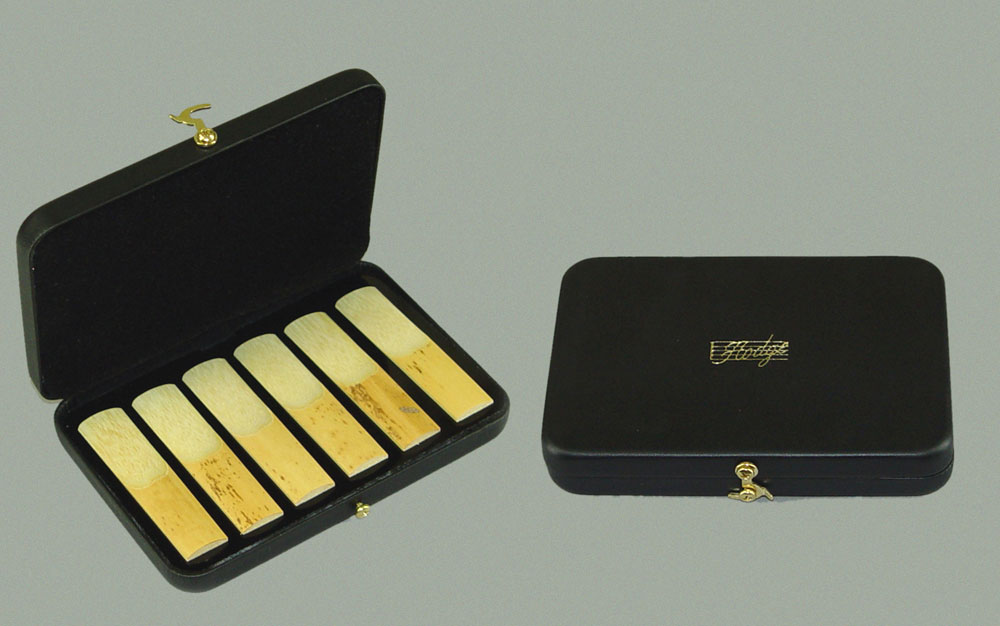
First, take a good look at it. Hold the saxophone reed up to a bright light and examine it for any chips, cracks, or holes. Do not choose any with those defects. Be alert for discoloration in the wood grain. If you see discoloration with a non-uniform wood grain, then discard that reed. Ensure that the wood grain is not coarse and has a consistent width. The reed should look as uniform as possible. Inspect for flatness, and watch for imperfections. A slight curvature is acceptable, but it should be limited.
Now, lets check for stiffness. If the store allows, gently flex the reed. Be careful not to break it! A nice reed should be slightly stiff. If the reed feels loose (you will get better at this with experience), then choose another. A loose reed can indicate that it is out of balance, and it is important to eliminate this potential problem.
If you perform the steps above, you will definitely increase your chance of finding quality saxophone reeds. Now keep in mind, it is not always possible to eliminate bad reeds. Since it is not possible to play the reed before purchase, I recommend buying multiple reeds at one time in case of problems. I hope this article increases your chance of selecting quality saxophone reeds


How to Form a Correct Saxophone Embouchure

Embouchure means the way you put your mouth on the instrument. The saxophone embouchure is different than most of the other instruments, but has a lot in common.
First say the word "OOO" and form this with nice round lips. Next, put your bottom lip over your bottom teeth so that your teeth are cushioned by your lip. You don't want to put too much lip over the teeth. The mouthpiece is placed in the mouth about 1/2 inch. It should go in the mouth at a 90 degree angle to your face.
Now, close the lips around the mouthpiece, kind of like closing a drawstring bag or purse. Don't bite down on the mouthpiece, but surround the entire mouthpiece with an even pressure. Your top teeth will go directly on top of the mouthpiece. Remember that the bottom lip covers the bottom teeth, and the top teeth go on the top of the mouthpiece.


Joe Henderson - Virtuoso Jazz Saxophone

Joe Henderson has been called a supreme melodist by one music writer, a musical astronaut by another jazz musician, and by a lucky few he has been called teacher. Two of my saxophone teachers took lessons from him in San Francisco and I hear some cool stories about him.
Joe Henderson truly personified musical greatness; he played the saxophone, drums, piano, flute, and bass as well as excelling at composition. It was by listening to jazz sax greats like Lester Young, Flip Phillips, Stan Getz, Lee Konitz, and Charlie Parker on his brothers record player that Henderson found his greatest inspiration.
In the mid-fifties, before he was even old enough to start college, Henderson was active in the Detroit jazz scene and played with many visiting stars from New York. By the time he did get to college, he had transcribed and memorized an impressive number of Lester Young solos. Such an impressive amount, in fact, that his professors believed him to have that elusive skill known as perfect pitch.


Everything You Always Wanted to Know About Sax

Sax can be embarrassing and awkward, especially if you are just starting. It can help to have someone experienced guide you through the first steps. In time, anyone can become proficient at sax.
Hmmm...
Puns aside, while being one of the most versatile and interesting instruments, saxophone ranks up there with violin on my personal list of annoying instruments to listen to a beginner play. All reed instruments are challenging to learn to control, but saxophones are made of metal so they tend to be a lot louder. Plus there are a huge variety of acceptable saxophone sounds and you might not be sure what to shoot for. It just doesn't sound good when someone picks up the horn for the first time and starts honking and bending notes like they're in some kind of bad fifties rock band.
If you are just starting out and having trouble, the first things I would recommend are: